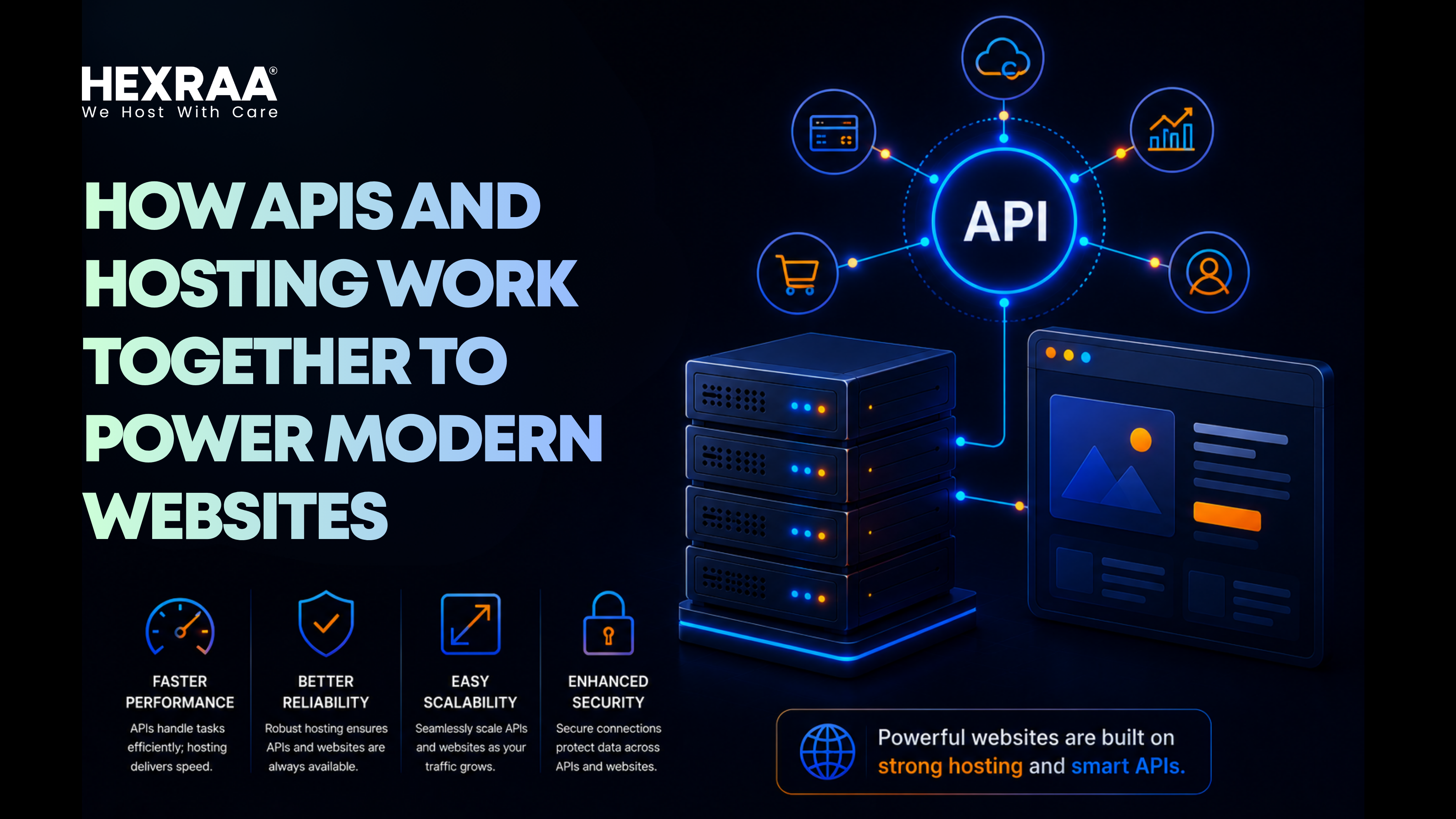
How APIs and Hosting Work Together to Power Modern Websites
Modern websites are no longer simple static pages with text and images. Today’s websites rely on advanced technologies, cloud infrastructure, real time communication, and third party services to deliver fast, interactive, and personalized experiences.
Behind every modern website, two essential components work together continuously: APIs and hosting.
Hosting provides the infrastructure that stores website files, databases, and applications, while APIs enable communication between different services, platforms, and applications. Together, they form the foundation of modern digital experiences.
From e commerce platforms and SaaS applications to social media websites and online learning systems, APIs and hosting power almost every aspect of the internet.
What is Website Hosting?
Website hosting is the service that stores website files and makes them accessible on the internet.
When users visit a website, their browser sends a request to the hosting server. The server then delivers the required content such as:
- HTML files
- Images
- Videos
- Databases
- Scripts
- Applications
Hosting acts as the backbone of a website by ensuring that it remains online, fast, secure, and accessible to visitors at all times.
Modern hosting solutions often include:
- High performance servers
- SSD or NVMe storage
- Security protection
- Automatic backups
- Scalability
- CDN integration
- Uptime monitoring
Without reliable hosting, even the best designed website may suffer from slow performance and downtime.
What are APIs?
API stands for Application Programming Interface.
An API allows different software applications to communicate and exchange data with each other.
Instead of building every feature from scratch, developers use APIs to connect websites with external services and tools.
For example, APIs help websites integrate:
- Payment gateways
- Login systems
- Maps and location services
- Social media platforms
- Email services
- Chat systems
- Analytics tools
- Cloud storage
- AI powered applications
APIs make websites smarter, faster, and more flexible by enabling real time functionality and seamless integrations.
How APIs and Hosting Work Together
Hosting and APIs work together to deliver modern web experiences efficiently.
The hosting server runs the website and processes user requests, while APIs connect the website with external services to provide additional functionality.
Here is how the process works:
- A user visits a website hosted on a server.
- The website sends requests to APIs for specific functions.
- APIs retrieve or process data from external services.
- The hosting server displays the final content to the user.
This communication happens within seconds and creates smooth digital experiences for users.
Real World Examples of APIs and Hosting Working Together
1. E Commerce Websites
Modern online stores use APIs for multiple functions such as:
- Payment processing
- Shipping calculations
- Inventory management
- Product recommendations
- Customer authentication
The hosting infrastructure handles website traffic, stores databases, and ensures fast performance during peak shopping periods.
Together, APIs and hosting create secure and scalable online shopping experiences.
2. Social Media Platforms
Social media websites rely heavily on APIs to manage:
- Real time notifications
- Messaging systems
- Media uploads
- Third party integrations
- Content sharing
Powerful hosting infrastructure ensures fast loading speeds, media delivery, and reliable uptime for millions of users.
3. Streaming Platforms
Video and music streaming platforms use APIs for:
- User authentication
- Content delivery
- Recommendation systems
- Playback synchronization
Hosting servers and CDN networks help deliver high quality media with minimal buffering and low latency.
4. SaaS Applications
Software as a Service platforms depend on APIs for:
- Cloud integrations
- User management
- Automation tools
- Data synchronization
- External software connections
Scalable hosting environments allow SaaS platforms to handle growing traffic and complex workloads efficiently.
Benefits of APIs and Hosting Integration
Faster Development
APIs allow developers to integrate ready made services instead of building every feature from scratch.
This speeds up website development and reduces operational complexity.
Better Scalability
Modern hosting infrastructure can scale resources based on traffic demands.
APIs also support scalability by enabling modular and flexible system architecture.
Improved User Experience
Fast hosting combined with efficient APIs creates smooth and responsive user experiences.
Users can enjoy:
- Quick loading times
- Real time updates
- Secure transactions
- Personalized content
- Seamless interactions
Enhanced Security
Hosting providers implement security features such as:
- Firewalls
- DDoS protection
- SSL certificates
- Malware scanning
At the same time, APIs use authentication methods and encrypted communication to protect sensitive data.
Greater Flexibility
Businesses can easily add new features and integrations through APIs without rebuilding the entire website infrastructure.
This allows websites to adapt quickly to changing business needs.
The Importance of High Performance Hosting for APIs
APIs depend heavily on hosting performance.
If the hosting server is slow or unstable, API requests may fail or experience delays, negatively affecting the website experience.
High quality hosting helps APIs perform efficiently by providing:
- Fast server response times
- Reliable uptime
- Optimized databases
- High bandwidth
- Low latency connectivity
- Scalable resources
Modern businesses require hosting environments capable of handling large volumes of API traffic without performance issues.
Cloud Hosting and API Driven Websites
Cloud hosting has become highly popular for API powered applications because it offers:
- Flexible scalability
- High availability
- Load balancing
- Global server distribution
- Faster deployment
- Resource optimization
Many modern applications use API first architecture where APIs become the central communication layer across platforms and devices.
Cloud hosting supports this architecture by providing reliable and scalable infrastructure.
Why APIs and Hosting Matter for Business Growth
Businesses today rely on digital platforms to connect with customers, automate operations, and deliver online services.
A strong combination of APIs and hosting helps businesses:
- Improve website performance
- Increase customer satisfaction
- Launch features faster
- Scale operations globally
- Improve reliability
- Enhance security
- Support future growth
Modern websites are expected to be fast, interactive, and always available. APIs and hosting work together to meet these expectations.
Frequently Asked Questions
What is the relationship between APIs and hosting?
Hosting provides the infrastructure that runs a website, while APIs allow the website to communicate with external services and applications.
Why are APIs important for modern websites?
APIs enable websites to add advanced features such as payment systems, social logins, maps, analytics, and real time updates without building everything manually.
Does hosting affect API performance?
Yes. Slow or unreliable hosting can delay API requests and negatively impact website speed and functionality.
Which hosting is best for API driven websites?
Cloud hosting and high performance VPS hosting are commonly preferred for API based websites because they provide scalability and reliable performance.
Can websites work without APIs?
Simple static websites can work without APIs, but most modern websites use APIs to provide advanced functionality and interactive user experiences.