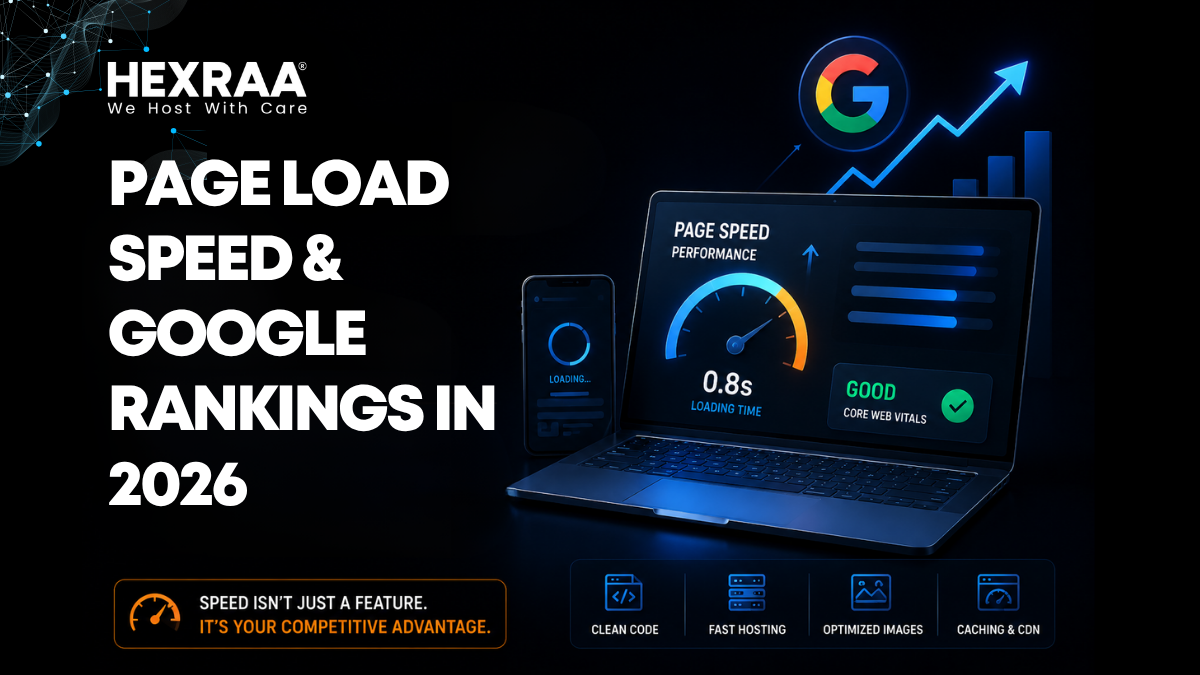
In 2026, page load speed is no longer just a technical detail. It plays a major role in how well your website performs in search results, how users experience your site, and how successful your business can be online. Google now gives more importance to fast and smooth websites. If your site is slow, visitors may leave quickly and your rankings can drop.
This blog explains how page speed affects Google rankings, why it matters more now, and what you can do to improve it.
What is Page Load Speed
Page load speed is the time it takes for a web page to fully load and become usable. This includes text, images, videos, and interactive elements.
It is not only about how fast the page appears, but also how quickly users can click, scroll, and interact with it. Sometimes a page looks ready but still feels slow because parts of it are not responding yet.
Why Page Speed Matters in 2026
- User expectations have increased. People want websites to load instantly. Even a small delay can cause frustration and make users leave.
- Mobile usage is now higher than ever. Since mobile networks can be slower or unstable, optimizing speed is very important.
- Competition is strong. Many websites offer similar content. If your site is slower than others, users will choose faster options.
Google’s Core Web Vitals in 2026
- Google measures page experience using Core Web Vitals. These are important for rankings.
- Largest Contentful Paint or LCP measures how quickly the main content loads. It should happen within 2.5 seconds.
- Interaction to Next Paint or INP checks how fast your page responds when a user interacts with it.
- Cumulative Layout Shift or CLS measures how stable your page layout is while loading. Content should not move unexpectedly.
- If your website performs poorly in these areas, your rankings may drop.
How Page Speed Affects Rankings
- Page speed affects rankings both directly and indirectly.
- Google uses page speed as a ranking factor. Faster websites have an advantage, especially when content is similar.
- A slow website increases bounce rate. Users may leave before the page finishes loading, which signals poor experience.
- Faster pages improve dwell time. Users stay longer and explore more pages.
- Speed also helps search engines crawl your site more efficiently, which improves indexing.
Impact on User Experience
- Page speed is closely linked to user experience.
- A fast website keeps users engaged, builds trust, and increases conversions.
- A slow website frustrates users, reduces credibility, and leads to lost opportunities.
In 2026, user experience is essential for success.
Page Speed and Mobile First Indexing
Google mainly looks at the mobile version of your site for ranking.
If your mobile site is slow, your rankings can drop, traffic can decrease, and conversions can suffer.
Optimizing for mobile speed is now a basic requirement.
Common Causes of Slow Speed
- Large images are one of the biggest reasons for slow loading.
- Too many HTTP requests can delay loading because each file needs to be fetched.
- Heavy JavaScript can slow down interaction.
- Poor hosting can affect server performance.
- Lack of caching forces the site to load everything from the beginning each time.
How to Improve Page Speed
You can improve your page speed with a few practical steps.
- Optimize images by compressing them and using formats like WebP or AVIF.
- Use a CDN to deliver content faster based on user location.
- Enable browser caching so returning users load your site quicker.
- Minify CSS, JavaScript, and HTML to reduce file size.
- Improve server response time by choosing good hosting.
- Use lazy loading so images and videos load only when needed.
- Limit plugins and third party scripts to reduce load.
Role of AI in Optimization
In 2026, AI tools help improve page speed more efficiently.
They can compress images automatically, detect performance issues, suggest fixes, and optimize code in real time.
Using AI saves time and keeps your site running smoothly.
Page Speed and Conversions
Page speed also affects your revenue.
Even a one second delay can reduce conversions. Faster websites increase sales, improve user satisfaction, and boost engagement.
If you want better results, speed should be a priority.
Measuring Page Speed
You should regularly check your website’s performance.
Track load time, Core Web Vitals, Time to First Byte, and full load time.
Regular checks help you find problems and improve your site over time.
Future Trends
Page speed will continue to evolve.
Edge computing will reduce delays by processing data closer to users.
Browsers will become better at loading content efficiently.
Automation will handle more optimization tasks.
Google may introduce stricter requirements for speed and user experience.
Final Thoughts
In 2026, page load speed is a key part of SEO and user experience. A fast website can improve rankings, increase engagement, and boost conversions.
A slow website can limit your growth, even if your content is good.
If you want to stay competitive, focus on making your website fast and smooth for users.
FAQs
Is page speed important for SEO in 2026
Yes, it is still a key ranking factor because Google values user experience.
What is a good page load time
A good load time is under 2 to 3 seconds, and faster is always better.
Does page speed affect mobile rankings more
Yes, because Google uses mobile first indexing.
Can a slow website still rank well
It is possible, but much harder if competitors have faster sites.
What is the most important speed metric
Core Web Vitals, especially LCP and INP, are very important.
How often should I check page speed
At least once a month or after major updates.
Do images slow down websites
Yes, especially if they are large or not optimized.
Does hosting affect speed
Yes, good hosting improves performance significantly.
Are there tools to test speed
Yes, many tools can analyze your website and suggest improvements.
Is improving speed expensive
Not always. Many fixes like image optimization and caching are low cost or free.