Domain Names That Made Millions And Why They Worked
A single web address once sold for $872 million. That was Car.com and it wasn't a fluke. In the digital economy, a premium domain name is not just a URL. It is a brand asset, a trust signal, and in many cases, a multimillion dollar investment.
Over the past two decades, certain domain sales have rewritten the rules of digital real estate. Understanding why these names commanded such prices reveals timeless principles about branding, psychology, and market timing insights that remain just as relevant for anyone building a business or investing online today.
The Biggest Domain Sales in History
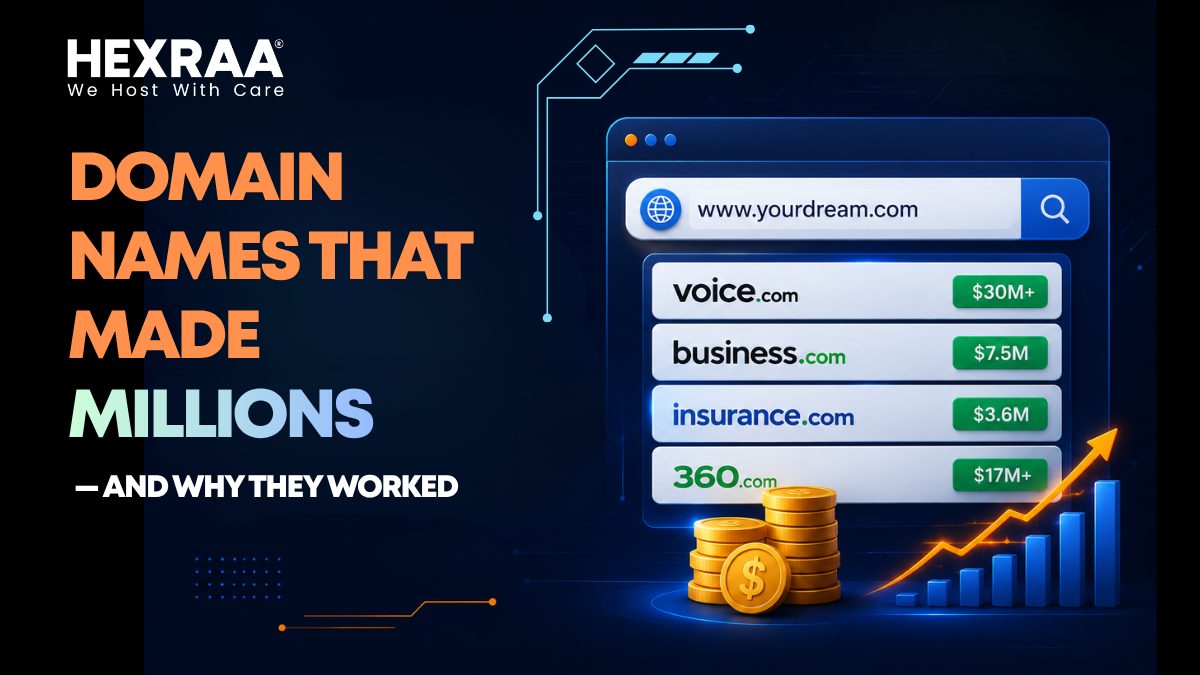
Some of the most significant domain sales illustrate a clear pattern: short, keyword rich, category defining names attract premium buyers.
• Car.com — $872 million (2010, absorbed into the Autobytel network)
• Insurance.com — $35.6 million (2010)
• Voice.com — $30 million (2019)
• 360.com — $17 million (2015)
• NFTs.com — $15 million (2022)
• Hotels.com — $11 million (2001)
• eBet.com — Registered for ~$100, later sold for $1.35 million
Each sale tells a story not just of value but of timing, foresight, and the power of language in a digital world.
What Makes a Domain Name Worth Millions?
Premium domain values are not arbitrary. Several measurable factors consistently drive price:
1. Simplicity and Memorability
Short domains are easier to remember, faster to type, and less prone to misspelling. A name like 'Voice' or 'Hotels' communicates instantly. Research consistently shows that brand recall improves when names are one or two syllables. The cognitive load is lower, which means users are more likely to return directly rather than searching through a competitor.
2. Keyword Strength and SEO Value
Category-match domains those that exactly match a high volume search term carry inherent SEO advantages. Insurance.com or Hotels.com effectively own a keyword with millions of monthly searches. Beyond organic traffic, these names also improve click through rates because users immediately understand what the site offers. Exact match domains in competitive industries can save businesses tens of thousands of dollars in paid advertising costs every year.
3. Brandability
The best premium domains do more than describe a category they invite branding. Voice.com can represent anything from AI assistants to podcasting platforms. This versatility makes the name future proof and allows the business to evolve without the domain becoming a liability.
4. Timing and Trend Alignment
NFTs.com sold for $15 million at the peak of the NFT boom. The domain's value was magnified by cultural momentum. Investors who registered such names early when the industry was emerging captured enormous returns by the time mainstream buyers arrived. The principle: premium domain investors think in trends, not just in search volume.
5. Scarcity
Only one entity can own a specific domain at any given time. Unlike stocks or physical goods, premium domain names cannot be manufactured. This absolute scarcity creates a seller's market for top-tier names, especially those ending in .com still the most trusted and globally recognized extension.
6. Universal Appeal and Cross Market Relevance
Names that work across languages and cultures command higher prices. Short numeric domains like 360.com are especially valuable in Asian markets, where certain numbers carry positive cultural connotations and are highly memorable. Universal names eliminate localization barriers, giving them a global addressable market.
The Psychology Behind Premium Domain Names
Beyond utility, the psychology of a premium domain directly affects how users perceive a brand before they read a single line of copy.
Trust is immediate. A clean, professional URL signals legitimacy. Studies in consumer psychology show that users make trust judgments within milliseconds of encountering a brand and the domain is often one of the first signals they process. A company operating on voice.com feels categorically different from one using myvoiceapp solutions.net, even if the product is identical.
Authority is implied. Owning the category name positions a business as a market leader by default. Customers assume that whoever owns Hotels.com must be the definitive source for hotel bookings. This halo effect reduces the friction buyers feel before making decisions, whether that decision is to sign up, purchase, or partner.
The effect extends to investors, press, and potential acquirers all of whom use the domain as a quick proxy for how seriously to take a business.
Domain Names as Investment Assets
Domains have become a recognized alternative asset class, comparable in some ways to real estate. Like property, they can be bought, held, leased, or sold. Unlike property, the transaction costs are minimal and the market is global and always open.
What separates successful domain investors from gamblers is pattern recognition. The best investors study language trends, monitor industry emergence, and identify gaps between what people search for and what good domains are available. The eBet.com story registered for roughly $100, sold for $1.35 million illustrates that insight and patience can generate extraordinary returns without extraordinary capital.
Common investment strategies include:
• Targeting emerging industries early (AI, Web3, biotech, clean energy)
• Acquiring short, single word .com names in any vertical
• Buying exact match domains for high CPC keywords
• Holding established category domains and leasing them for recurring revenue
• Avoiding keyword stuffed, hyphenated, or trend-dependent names with no lasting utility
What Modern Founders Should Know
For entrepreneurs building a company today, the domain question is strategic, not cosmetic.
The rise of alternative extensions (.ai, .io, .co) has created more options, and many successful startups have built strong brands on non .com addresses particularly in tech markets where audiences are more sophisticated. But .com remains the default assumption for most users. When someone hears your brand name, they type .com. If that leads to a competitor, you have lost the click.
The smartest founders ask three questions before choosing a domain:
• Will users remember it after hearing it once?
• Will they find it without a search engine?
• Will it make investors and partners take us more seriously?
Companies like Better, Public, and Friend have invested heavily in premium naming precisely because the domain supports the product story rather than contradicting it. A premium domain removes doubt before the user even loads the page.
The Business Case for Paying More
A premium domain is not a vanity purchase it is a performance lever. In competitive industries like finance, insurance, travel, and healthcare, a great domain reduces customer acquisition costs, improves conversion rates, and builds brand equity that compounds over time.
The math is straightforward: if a strong domain converts 10% better than a weak one, the additional revenue generated over five years can far exceed what was paid upfront. That is why buyers in high stakes industries routinely pay six, seven, or eight figures for the right name. The return on investment is real, measurable, and durable.
The Future of Domain Value
Domain names are not becoming less important they are becoming more competitive. As the internet expands globally and new technologies create new categories, the demand for clear, authoritative, and memorable domain names will grow.
Emerging areas like artificial intelligence, decentralized finance, digital health, and the metaverse are generating entirely new vocabularies. The investors and founders who register the defining names in these spaces now at low cost will be sitting on significant assets as those industries mature.
Even as new extensions proliferate, .com retains its status as the gold standard. It is the extension that conveys credibility to the widest possible audience, across every demographic and geography. That status is unlikely to change in the near term.
Key Takeaways
• Short, single word .com domains consistently command the highest prices because they are scarce, memorable, and universally trusted.
• SEO value is embedded in category-match domains they bring organic traffic and reduce paid acquisition costs from day one.
• Timing matters. The biggest domain wins come from identifying emerging trends before they peak.
• Premium domains are a trust signal that influences user perception, investor confidence, and brand authority.
• Treat your domain as a long-term asset. The right name today can be worth multiples of its cost in five years.
Frequently Asked Questions
What makes a domain name valuable?
The most valuable domains are short, easy to spell and pronounce, end in .com, contain high value keywords, and have broad applicability across industries. Scarcity and timing also play a major role.
Can individuals invest in domain names?
Yes. Domain investing often called domaining is practiced by individuals and institutions worldwide. Successful domain investors study emerging trends and register names early, often for less than $15 per year, then sell them for thousands or millions when demand develops.
Are .ai and .io domains worth investing in?
Alternative extensions have real value in specific markets, particularly tech and startup communities. However, .com remains the benchmark for mainstream credibility. For most businesses targeting a broad audience, .com is still the stronger investment.
How do I find a good domain name for my business?
Start with your brand's core value proposition and choose a name that is one or two words, easy to say aloud, free of hyphens and numbers (unless numbers are part of the brand), and available in .com. If the ideal .com is taken, consider negotiating a purchase rather than defaulting to a lesser name.
A great domain name is one of the most cost effective brand investments a business can make. In an era where first impressions happen in milliseconds and trust is earned before a single word is read, the right domain does not just identify where you are it signals who you are.